Review – “Resonance Lines”
Painter: LTj – Format: A1
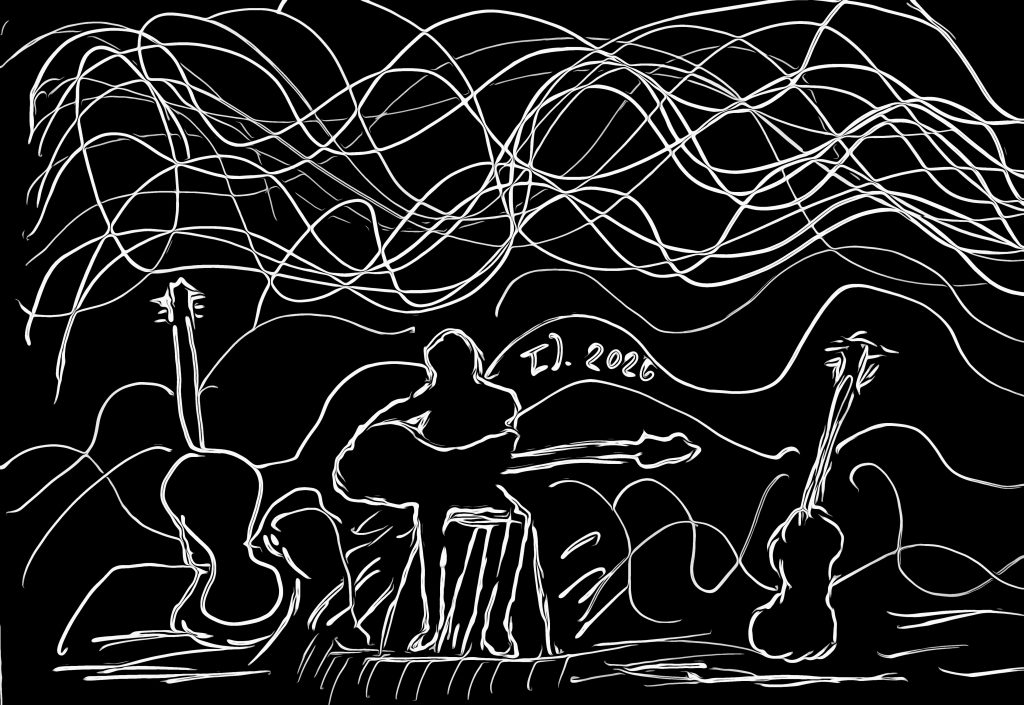
When I look at this A1 drawing, I see a space that feels both empty and full at the same time. I worked here with the simplest elements I could allow myself: a black field and white lines. Nothing more. The black background is not just a surface for me—it becomes a kind of silent room, an acoustic void in which everything else begins to move.
At the center I placed a musician. The figure sits on a stool with a guitar, but I deliberately kept the person anonymous. There are no facial details, no individuality beyond the outline. For me this figure is not meant to be a portrait. It is more like a vessel. It could be me, but it could also be anyone who has ever sat alone with an instrument and tried to turn silence into sound.
On both sides of the figure I drew two additional guitars. They stand quietly, almost like witnesses. When I look at them, they feel like other possibilities of the same musician. Different tones, different songs, different identities waiting to happen. A guitar can change the way a person speaks musically, and here these instruments represent those parallel voices.
Above the musician the drawing begins to open. White lines spread across the black surface in waves and curves. When I drew them, I thought of sound moving through space. Every note that leaves a guitar doesn’t disappear—it travels, reflects, multiplies, and transforms. These lines are my way of visualizing that invisible movement.
Sometimes they remind me of electrical signals, sometimes of wind currents, sometimes of the patterns you see when sound is translated into visual data. They cross each other, separate again, and reconnect somewhere else. None of them are perfectly controlled. I allowed them to wander, because sound itself never travels in a perfectly straight line.
The musician in the middle becomes the quiet origin of this movement. The body remains almost still, but the lines above suggest that something immense is unfolding from that stillness. For me that contrast is important: a calm human figure and an expanding field of energy around it.
Working in this minimal black-and-white style was also a conscious decision. Color can easily dominate an image, but here I wanted the viewer to focus only on rhythm, direction, and vibration. The white lines almost behave like illuminated threads in darkness, as if the music itself has become visible.
The more I look at the drawing, the more it feels like a map of resonance. The instruments are physical objects, but the lines above them belong to another layer—an invisible layer where memory, sound, and imagination overlap. When someone plays music, those things mix together in ways we rarely see. In this work I tried to give them a visual form.
The inscription “LTj 2026” inside the image is not placed like a traditional signature in a corner. I wanted it to exist within the field itself, almost as if it were another line in the network. The year marks a moment in time, but the movement of the lines suggests something that continues beyond that moment.
For me the whole composition is about the relationship between silence and expression. The black background represents the silence that always exists before a note is played. The musician sits inside that silence. Then the lines begin to appear, spreading outward like waves from a single point.
In the end, this drawing is less about a person playing guitar and more about the invisible architecture of music. I wanted to show how something as simple as a musician sitting alone can generate an entire universe of movement, vibration, and possibility.
And maybe that is the quiet idea behind the picture: that a single sound, played in stillness, can travel much farther than the musician who created it.